

Make Ilkley Tarn Great Again? Duck off
Ilkley Tarn’s duck population has gotten far too big, says a local conservation group. A dissenting voice claims otherwise …

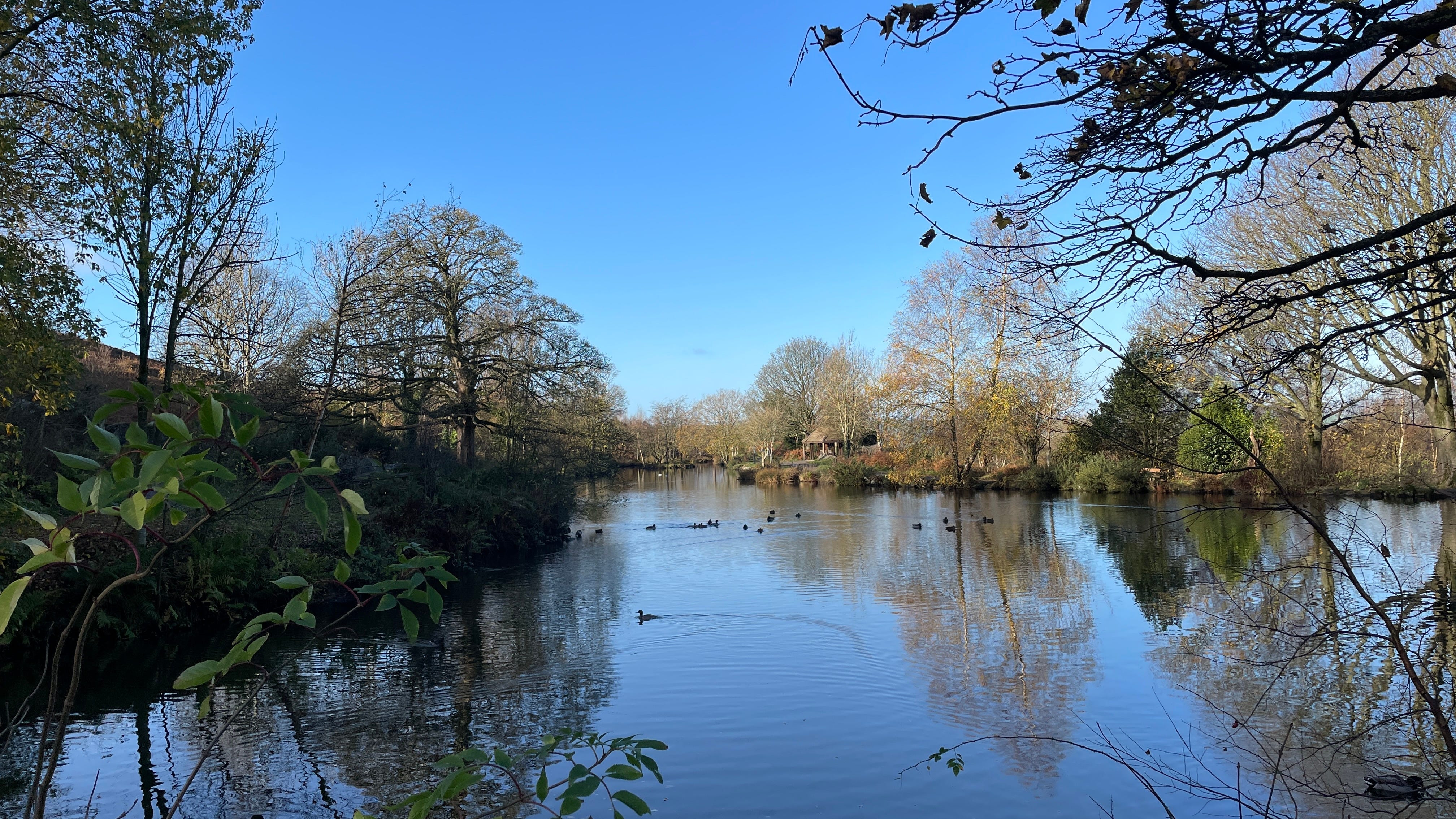
On Sunday 16 November, a leaflet made its way through the letterboxes of Ilkley. It was a good day for it – dry with very little wind and a modest chill that had replaced the unseasonably mild weather we’d had as of late. It wasn’t your usual junk mail. This was different. It was attention grabbing. It was clear that a lot of thought and budget had gone into it. Someone had something to say.
On one side of the leaflet, with the headline of DON’T FALL FOR IT, there’s an image of an anthropomorphised toad or a frog (maybe an unintentional hybrid of the two). It’s wearing a red plaid shirt, blue dungarees and a red MAKE TARN GREAT AGAIN baseball cap, an imitation of the red hat often worn by Trump and his more ardent supporters.
The creature is looking straight at us with a grumpy expression and menacing red eyes. It’s also, for reasons unknown, holding a frothy pint of beer. At the bottom of the leaflet there’s a call to action – VOTE AGAINST THESE CHANGES – and a link to a website.
On the other side, with the slogan YOUR TARN NEEDS YOU!, is a chipper-looking, anthropomorphised mallard duck (green head, yellow bill, white collar). It doesn’t appear to have wings. Instead, oddly it’s got human arms and human hands. It’s dressed in a creamy sailor’s suit, as well as a sailor’s cap featuring the emblem of an anchor on top of its head and a blue and white striped neckerchief around its neck. It’s in the style of the iconic 1914 Lord Kitchener British army recruitment poster for world war one.
There’s also a circular logo on the top left of the leaflet. The main image is of a pair of ducks – a male and female mallard respectively – floating on what looks like Ilkley Tarn. In the background, four further ducks can be seen flying as the sun sets or rises behind a pool of water. The outer ring has the same website url that features on the other side. The bottom of the logo is partially covered with the words CHOOSE DUCKS in a more bubbly font.
What is this leaflet all about? Why had someone gone to all this trouble? Why were we being asked to choose between waterfowls or amphibians? Inspired, we decided to take a look.


Ilkley Tarn has been a popular local and tourist attraction since 1873 when it was transformed from a dam (Crag Dam) into “pleasant place to visit and sit beside” all year round. In that respect, it’s largely manmade, a landscaped feature built into part of one of the lower sections of Ilkley Moor on its eastern fringes. What was more natural, however, was the way in which the tarn developed into a rich and diverse habitat for fish, amphibians, invertebrates and aquatic plants … not to mention the odd duck or two or three or more.
In fact, ducks have probably been around for as long as the tarn has. In the early days, this was both naturally occurring – where there’s a hospitable wetland, ducks will no doubt congregate – and engineered. For instance, on 29 October 1931, a pair of muscovy ducks (red caruncles, black and white feathers) which originally hail from the Americas, were introduced to Ilkley Tarn. Six years later, the Ilkley Gazette reported that with a little help from the council, they had raised eight chicks.
That number of ducks, though, has always been small, meaning that the ecosystem in and around the tarn has remained relatively balanced. It stayed this way for most of its history but, more recently, at some point in the 21st century, things started to change and the number of ducks here began to increase considerably. The main reason was that more and more people had started to feed them. The word got out among other ducks. Ilkley Tarn is serving up a feast.
On a very small scale, this, in itself, would have been fine. There’s nothing wrong with taking part in the still beloved national pastime of feeding birds (an activity that is thought to have started to enter into popular consciousness towards the end of the 19th century), the conservation group the Friends of Ilkley Moor, has explained. After all, it’s one of life’s small pleasures.
The problem here is that the now large and somewhat established population of ducks – according to Owen Wells, chair of the group, there were “well in excess of 100 ducks” at Ilkley Tarn at the start of the year – has been nothing short of an “ecological disaster” for the lake.
“Once the ducks have been fed, they jump back in the water and poop in it,” Wells tells us over a cup of tea in his kitchen a few days after the leaflets were first distributed. “The net result of all that poo is that the water quality in the lake is awful. The last time we did analysis it showed that the water in the tarn was so oxygen depleted that it was barely capable of supporting life.”
And that, today, means no stickleback fish, no toads and no aquatic life whatsoever. Just plenty of charming ducks who continue to excrete in already very dirty and polluted water. So long as people keep feeding the ducks, nothing will change and Ilkley Tarn will continue not to be a diverse area for nature as it once was.
But not everyone agrees.
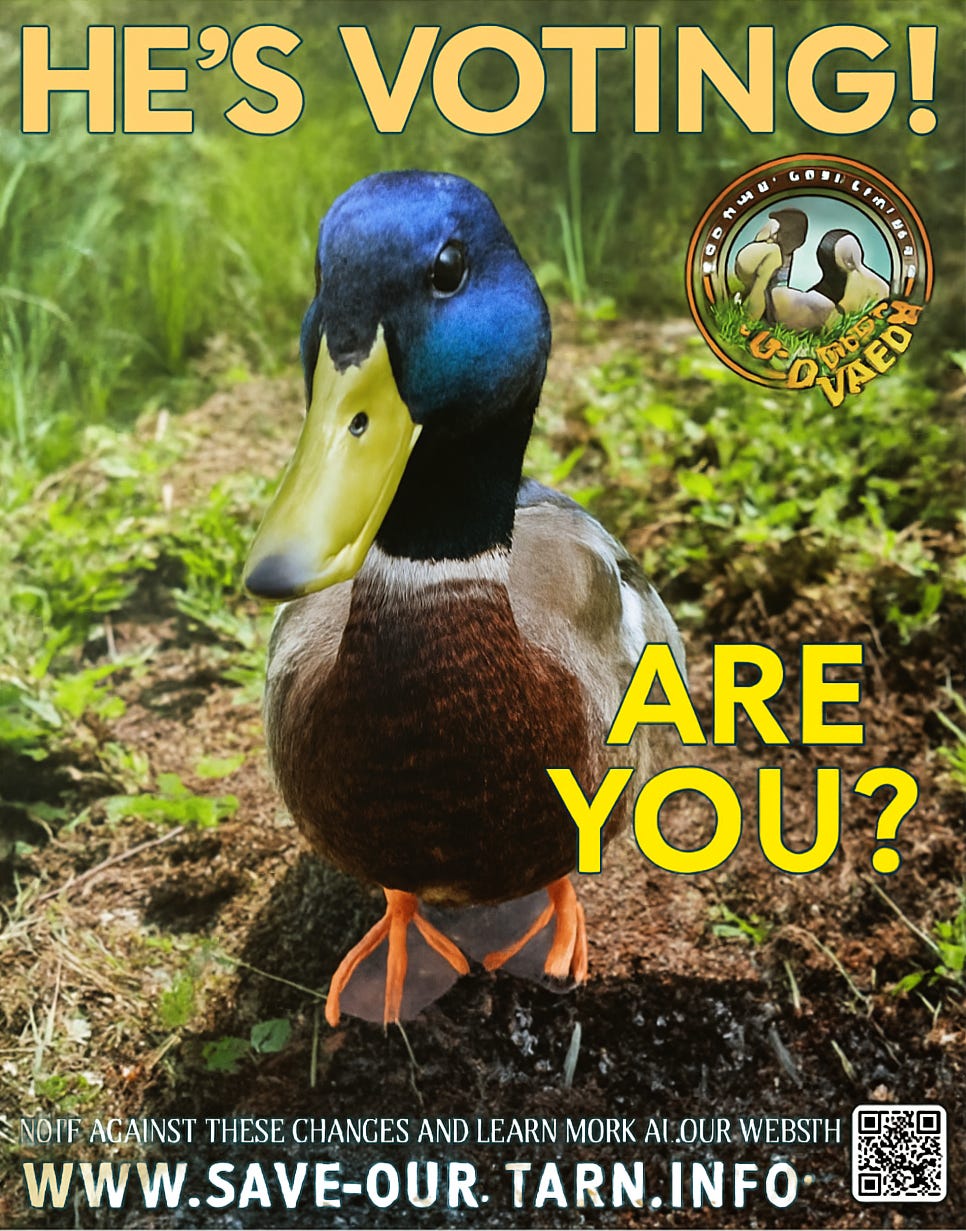
Earlier this year, sometime in late spring, signs started popping up around Ilkley, Wells says. The first ones were made from a correx, foam-esque material. The later ones were backed with sheets of metal. He brings one of them out for me. It’s roughly A3 in size and features a photograph of a duck. The logo that features on the leaflet that made its way into a few of Ilkley’s abodes recently is there, as is a link to the same website, which we believe went live sometime in May.
The headline on the poster reads: HE’S VOTING! ARE YOU? with supporting copy at the bottom urging people to learn more and back the pro Ilkley Tarn duck campaign and a QR code for convenience. Again, a lot of effort and thought has gone into this – and a few bob, too.
“Initially he started screwing the signs onto the trees, but when we started taking them down – as quickly as he put them up – he then started to add glue into the holes that he was screwing into,” Wells reveals. “And this caused unnecessary damage to the trees. It’s also illegal, as the trees are located on sites of special scientific interest. That said, we’re very pleased to say that for the past six weeks – perhaps even the past two months – no new posters that we know of have gone up.”
Wells believes the Save Our Tarn campaign began after Bradford Council-backed signs that were funded by the Friends of Ilkley Moor had gone up around Ilkley Tarn in early spring. In order to “protect our wildlife and natural spaces”, the signs politely ask visitors to refrain from feeding ducks or other birds here because, in doing so, it will encourage more of them to flock here.
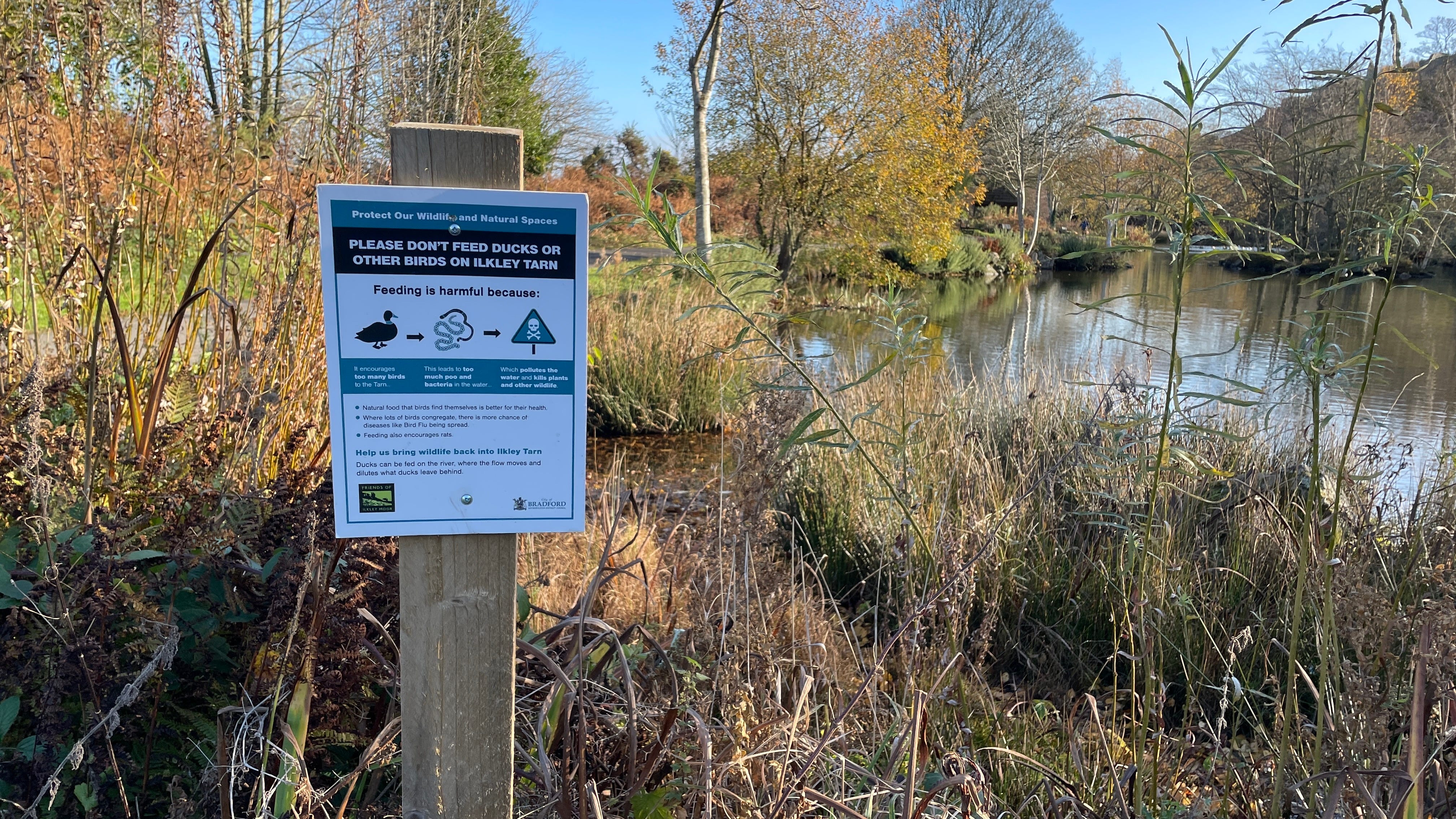
That alone wouldn’t necessarily be a problem. However, it’s all the number twos that a large cohort of ducks have and will make in the water that has ended up having a negative impact. It has polluted Ilkley Tarn.
As a result, plants and wildlife have been killed off and toads, which were once ubiquitous here, can no longer be found, Wells tells me. “I remember a time where my wife Delia and I used to walk up to and around the tarn in the evening with our dogs and, in the spring, in particular, you’d have to be really careful not to tread on toads, they were so numerous.” That was 30 or so years ago.
For the individual or individuals behind the so-called Save Our Tarn campaign, this sounds like nostalgia, bias even, an unmistakable preference for fish and amphibians over ducks, which Wells refutes (“we wish to see the widest possible variety of aquatic life here”).
“Fish and frogs are a dreadful alternative to ducks,” the campaign argues. “Fish are all-but invisible because of the reflectivity of the water. Frogs are shy and form a dull green blob in a sheltered corner. Neither are species that children or parents can interact with whereas ducks can be enjoyed by people of all ages.”
The campaign also claims that Ilkley Tarn is already biodiverse, attracting species like deer, geese, heron and moorhens. But this isn’t the argument the Friends of Ilkley Moor is making. It’s very specific to the lake itself. “I wish the tarn was a hotspot of biodiversity,” Wells says in response. “Sadly, when we had the water analysed it was so oxygen depleted as to be almost incapable of supporting life.”
The campaign also suggests that the water has been dirty since at least the 90s – and that this hasn’t caused any problems. Moreover, it goes on, it should have been dredged “every 20 years or so” but it hasn’t. Wells attributes the sorry state of the water to Ilkley Tarn’’s large duck population, who have been the single biggest factor in its deterioration. He also acknowledges that while, to the best of his knowledge, no-one has attempted to dredge the tarn, an attempt of sorts to remove fallen leaves from it around 10 years ago was made.
The campaign also suggests that far from being “dead” and “barren”, Ilkley Tarn is “thriving”, even though it can’t support fish and the ducks end up eating tadpoles, totalling some 50,000 by their estimates. Wells questions where this number has come from. “Who counted them?” he asks. “It’s an observable reality that the quantity of toad and frog spawn has greatly decreased as have the tadpoles. And we think the few that there are, are unlikely to survive.”
“Sometimes it’s necessary to challenge organisational group-think,” the Save Our Tarn campaign website states. “Does it matter if the tarn can’t support frogs and sticklebacks? It’s downstream of other water sources on the moors and it’s the perfect place for feeding ducks with young children …
“We’d like to thank everybody who fed those ducks over the last four decades. You have enriched the tarn for generations past and present, for residents and visitors alike. We ask you to continue.”
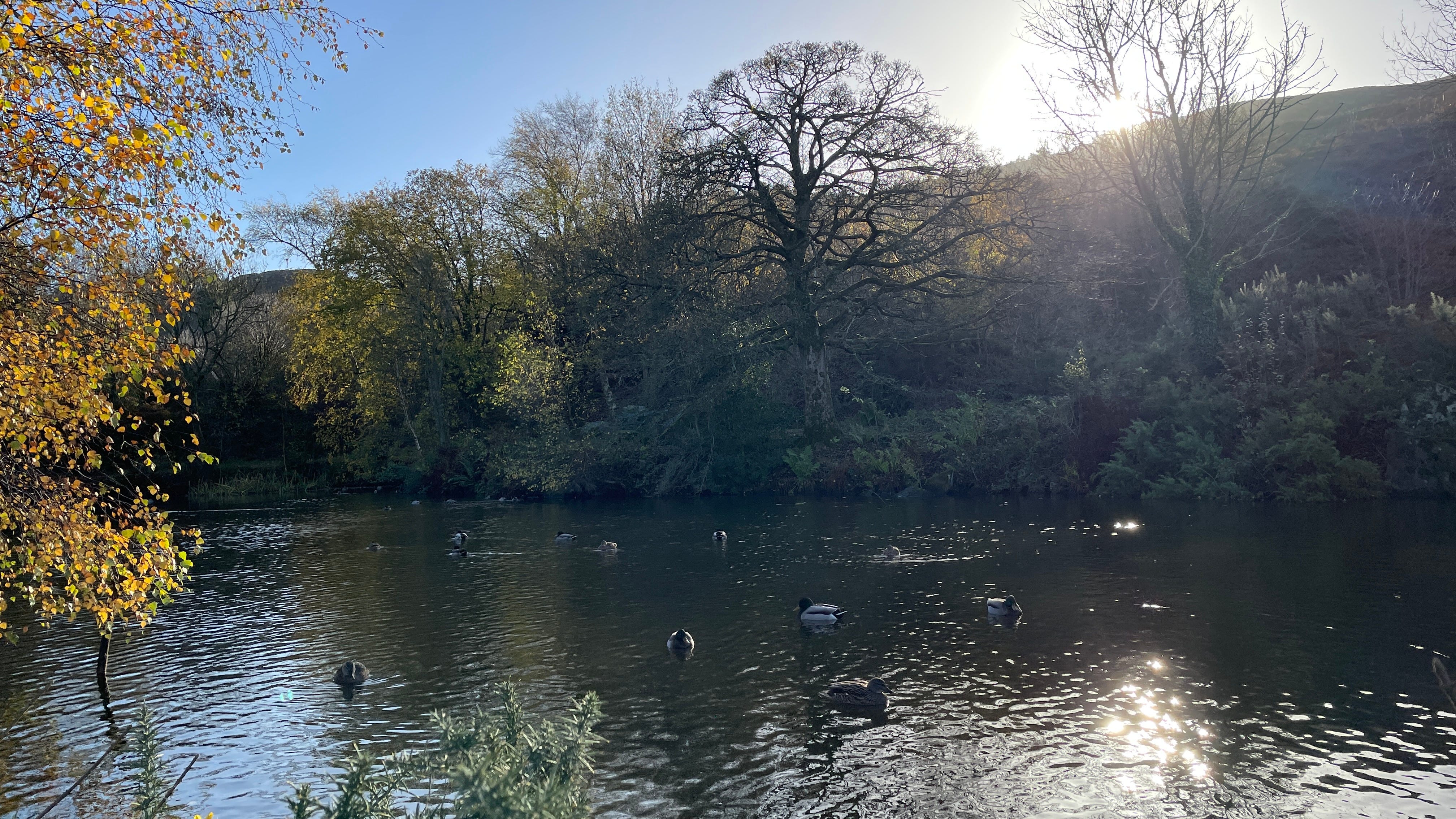
The petition, which went live earlier this year – objecting to frogs and sticklebacks “replacing” ducks on Ilkley Tarn, advocating instead for an increase in the amount of water flowing through it or dredging it, and replacing the current signs so that they instead “encourage responsible feeding” (i.e. no bread) – has so far attracted the support of 118 people (at the time of writing).
Given the size of Ilkley, not to mention the surrounding areas – Menston, Burley in Wharfedale, Addingham for example – the number of people backing the duck colony to remain on Ilkley Tarn appears to be modest, despite the best efforts of Save Our Tarn to rally people to their cause this year.
It suggests either the campaign’s reach has been limited (we’re assuming marketing has been entirely offline), that people really don’t care either way or that the overwhelming majority of local residents, while acknowledging the generational joy of seeing and feeding ducks, nevertheless appreciate the rationale behind the Friends of Ilkley Moor’s two-pronged renewal plan for the tarn.
The first, which has been discussed here, is to massively reduce the number of ducks on Ilkley Tarn. The second and more “ambitious” part of the plan, which requires Environment Agency and Bradford Council sign-off, requires much more intervention in the landscape. It’s pretty technical (the detail of which is available on the conservation group’s website), but the basic premise is to increase the flow of fresh, oxygenated water into the lake over a period of two to three weeks, which will, it is hoped, replace enough of the existing water to improve its overall quality and begin anew its regeneration.
“Our intention is to allow aquatic plants to recolonise the site through natural dispersal allowing two to three years for that process to occur,” the Friends of Ilkley Moor said in early November. “Within the same period of time a greater range of invertebrates should appear and amphibians should restart breeding in the tarn. And who knows, but a few years thereafter, sticklebacks might return.”
It’s worth noting that under these proposals, Ilkley Tarn wouldn’t be without ducks. They’d still be here but the numbers would be very small. The ideal would be no more than a pair, which would keep all things nature very well balanced.
Wells, who was previously a Green Party councillor for Ilkley West on Ilkley Town Council, concedes that getting it down to that number will be a massive challenge, wishful thinking even. Getting them down to a dozen or so ducks, for instance, would also probably still be fine. The lake would still have a fighting chance to recover with a number like that.
And that’s all there is to it, Wells concludes. It has nothing to do with politics, there’s no anti-duck, pro-toad-slash-stickleback agenda, no wistfulness for days gone by. This is simply about bringing biodiversity back to Ilkley Tarn, nothing more, nothing less.
And what about feeding ducks? Where in Ilkley, if not the tarn, can people enjoy this activity? Though the Save Our Tarn campaign will disagree with the following recommendation, Wells recommends that people head to the river where there are plenty of safe and scenic places to do it (and where, as a bonus, the flow of the water naturally flushes away any poo, too). It’s a win-win for everyone, ducks included.
Except, well …
Great article. What I particularly didn't like was the way the duck campaign seemed anonymous. I sent an email to the campaign (through the petition website) asking who was behind it but never got a response.