


Living as we do in the long aftermath of the 2008 financial crisis and a post-meaningful world of growth – coupled with the anti-worker agenda of AI, as the internet sage Ethan Zuckerman has described the technology being hammered out by capitalist tech bros in search of their own versions of utopia (while pocketing a pretty penny) – it’s not all that surprising to learn that the number of race-related hate crime being recorded in West Yorkshire has increased significantly over the past 15 years. It’s also been reported recently that hate crime more generally is on the up again in England and Wales.
There’s a sort of sad inevitability about it, with deep-set economic hardship, a dearth of opportunities and an existential, uneasy sense of professional and even personal spiritual drift in a country that has been unable to shake off its own sense of misplaced grandeur – emphasis on the great in Great Britain now crudely articulated in some right-wing circles like a cheap knock-off as Make Britain Great Again – often rationalised through the prism of race, religion and the like.
Just look at the enduring and inherently reductive debate about immigration and asylum seekers, terms that are carelessly used interchangeably and, more often than not, cruelly when prefixed with the word “illegal”. Whether it’s from a far-right perspective or what we can loosely describe as the centre, when concerns about immigration are expressed – and used as a political prop for either gain or preservation depending on where you’re currently sitting – it’s almost exclusively levelled against anyone we can clumsily bundle together as being ethnically diverse.
Suggesting otherwise is just a form of denial, a coping mechanism to placate the uneasy aspects of power – namely having to bench or at least temper one’s values and morals – or a way of masking an outright lie, whereby one feigns indignation while continuing to whistle at the dogs. Make no mistake that whenever anyone talks about the people supposedly taking our jobs, our benefits, our hotels and even our swans, it’s very much directed towards the visible other.
Economics, of course, isn’t the only factor at play behind the increase in race-related hate crime in West Yorkshire (and beyond). There are social and cultural aspects to it, as well as pseudoscientific ones, while mental health problems play a role in it more granularly.
The result is a complex, knotty, Freudian mess of psychology playing out haphazardly in an increasingly globalised and multicultural world that has enabled more and more people to make new homes not just for themselves but possibly for generations of their family to come (although, let’s not be under any illusion, that England and Wales, according to the 2021 census, 81.7% – 48.7 million – of people “identified their ethnic group within the high-level “white” category).
Seeing others through a racial lens is why we end up having pointless, muddled and damaging debates about who can legitimately call themselves English or British 25 years into the 21st century, resulting in the bizarre spectacle of one daughter of immigrants, Suella Braverman, arguing that she is not English, and one son of immigrants, Rishi Sunak, defending himself against suggestions to the contrary.
The absurdity of that discussion can perhaps be best understood through the beautiful game, something that Sunak, to his credit, touched on in an interview with the BBC journalist Nick Robinson earlier this year. Who then gets to play football for England if Englishness is rooted exclusively in ethno-nationalism as opposed to civic nationalism?
The quasi-normalisation and rising frequency of this kind of unhelpful, offensive and questionable thinking, expressed more freely and publicly by more and more people than we would have thought possible even a few years ago, has arguably proliferated in tandem with the increase in recorded race-related hate crime in the region, which has gone up from 2,077 in 2010/11 to 6,254 in 2024/25, with a high of 7,264 in 2021/22, according to figures provided to The Ilkley Journal by West Yorkshire Police via a FOI.
Both are therefore symptoms of economic malaise – the Institute for Fiscal Studies has described the years between 2010 and 2024 “as a period of abysmal growth in productivity, and with it, living standards” – where a feeling of resentment, disregard and abandonment, coupled with the habitually dangled but always unfulfilled promise of another post-second world war boom (hitherto limited to the mid to late 50s and 60s), has found, for some, an outlet and a home in anger and rage.
In searching for answers, somewhere to channel that indignation, someone or something to blame, old tropes and prejudices have re-emerged, lazy system one responses to a complicated and unforgiving world. And they catch on, these stubborn, historical biases – these impossible grudges – that were formed long ago and which linger, like a virus, in the air, rising and falling and adapting and evolving as it patiently waits for an opportune moment to turn contagious and spread from one vulnerable person to the next.
Consequently, when shit hits the proverbial fan, as it often does, pinning the blame on a particular cohort of immigrants – i.e. people of colour, another simplistic catch-all for anyone that’s not white, but useful nonetheless – past, present and future, comes easy. Because, from Enoch Powell’s “as I look ahead, I am filled with foreboding, like the Roman, I seem to see the River Tiber foaming with much blood” to Nigel Farage’s “only Reform UK will stop the invasion”, there has been a long history in Britain of instinctively and irrationally framing social, cultural and economic problems along racial and by implication religious lines.
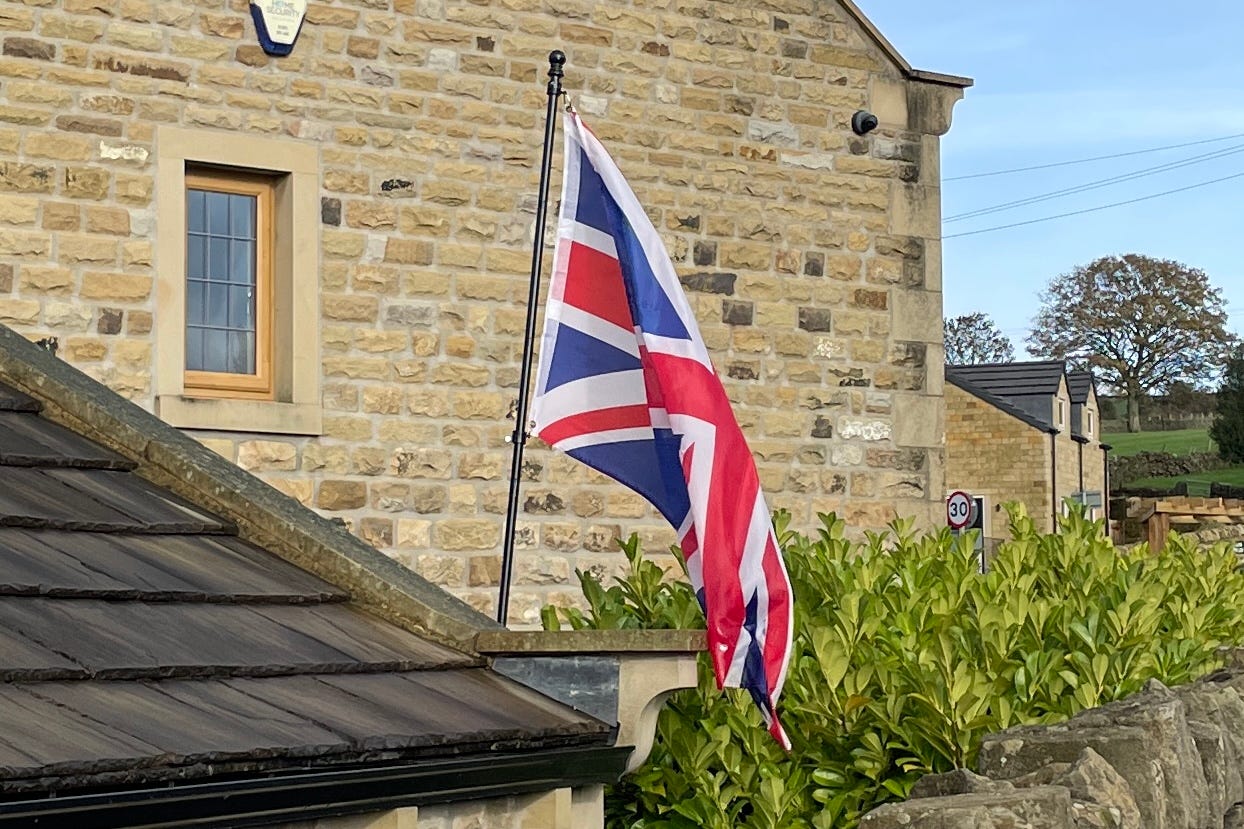
And it’s encouraged. For instance, look how far the Overton Window has shifted on how race, identity and nationality are discussed and expressed in public by everyone from your average Joe putting up a flag to say, far from patriotically, that This Is England, your relentless far right agitator who ideological allies brazenly wear “generation remigration” t-shirts in front of scores of people and your centre right and right-wing politician suggesting that the now former PM, born in UK, “doesn’t understand our culture”.
It has changed that much in the UK that even the UN has expressed concern about the “persistence of hate crimes, hate speech and xenophobic incidents on various platforms and by politicians and public figures [and] recurring racist acts and violence against ethnic and ethno-religious minorities, migrants, refugees and asylum-seekers” in 2024.
(Incidentally, the stats around recorded faith-related hate crime in West Yorkshire are interesting, as according to the stats provided to us by West Yorkshire Police, the numbers don’t match the levels of race and sexual orientation, a hate strand that saw an increase from 164 to 1,288 over the same period in the region. Faith has gone up from 22 to 583.)
Some examples. Zia Yusuf: “In the last eight years, more people have turned up on the beaches, illegally, uninvited, the majority of them men, the majority of them fighting age men that hate this country, including countries like Afghanistan, Syria.” Nigel Farage: “We are not far away from major civil disorder … it is an invasion as these young men illegally break into our country.”
Suella Braverman: “Let’s be clear about what is really going on here: the British people deserve to know which party is serious about stopping the invasion on our southern coast and which party is not.” Douglas Carswell: “From Epping to the sea, let’s make England Abdul free.”
Unashamedly coarse, deliberately provocative, this kind of language is designed to agitate and manipulate people, ultimately for political gain. It implies that all non-white immigrants are a threat to personal safety, to livelihoods and to a so-called homogenous British culture that has never existed except in fairytales. But this distorted narrative doesn’t just stay with immigrants, which is, in itself, a problematic and facile assessment. That supposed threat is also extended to anyone and everyone with a different skin colour, no matter their history on this island, no matter their contributions, from culture to the economy.
It’s how and why we end up with Robert Jenrick appearing to explain what he sees as evidence of societal problems on purely racial and ethnic terms: “I went to Handsworth … to do a video on litter and it was absolutely appalling. It’s as close as I’ve come to a slum in this country … It was one of the worst integrated places I’ve ever been to … In the hour and a half I was filming news there, I didn’t see another white face.” The Bishop of Birmingham said that comments like this “can feed into a harmful narrative that provides fuel for a fire of toxic nationalism”. Trade Unions, meanwhile, said that they “stand together in calling out his racist characterisation”.
The writer, Richard Seymour, describes this growing sense of antagonism and xenophobia in the UK and, more generally, around the globe, as disaster nationalism, an apocalyptic fever that has many, many people convinced that this is a Manichean battle between good and evil, between Brits and non-Brits (or is that between the English and the non-English?), between whites and non-whites and even between assimilated minorities and non-assimilated minorities.
Populists, unsurprisingly, thrive in this kind of environment, as they always have done during periods of economic downturn, adept as they are in explaining the economic failures of liberal democracy – more recently delivered through the catastrophic ideology and architecture of neoliberalism – in emotive, simplistic and Machiavellian ways.
“[Disaster nationalism] offers the balm, not just of vengeance, but of a sort of violent reset which restores the traditional consolations of family, race, religion and nationhood, including the chance to humiliate others,” Seymour explained in an interview with the Guardian last year. As the journalist Daniel Trilling distilled it in the LRB earlier this year in a review of Seymour’s book, with no actual meaningful solution to society’s problems being tabled by any political party – take, as an example, as the Times reported recently, that up to eight Reform-led councils, which sold voters a dubious claim of cutting wasteful spending and bills, are considering (a euphemism for will be) increasing council tax in 2026 – all that can then be offered, on the right, is revenge. The “true payoff is psychological”.
Which nicely brings us back to what I suppose is the central argument being explored in this essay, that poor economic conditions – the writer and historian Perry Anderson, also in the LRB, described the social consequences of neoliberalism as being “a steep and in some cases staggering escalation of inequality; long-term wage stagnation; a spreading precariat” (and, also worth noting, some of the political consequences as being the “growing interchangeability of parties [and the] erosion of meaningful electoral choice) – is a leading cause, in a direct and indirect way, in the increase in race-related hate crime being recorded in West Yorkshire (applicable also, as is evident, to every other region experiencing a similar surge in numbers).
And West Yorkshire does indeed have some serious economic problems, with the West Yorkshire Combined Authority (WYCA) acknowledging that while the local economy is growing, it nevertheless “faces structural economic challenges”. “In common with most areas in the north of England, West Yorkshire’s productivity level is below the national average: the deficit emerged in the period following the global financial crisis and the gap has not narrowed over the last decade,” a 2024 WYCA Labour Market Report stated. “The quality of the area’s skills base is an important factor in the productivity deficit but other factors, including a lack of capital investment, also contribute to the issue.”
Pay levels, it continued, are lower than the national average, with 14% of jobs paying below the real living wage. Pockets of acute deprivation are widespread – the region has “twice its ‘fair share’ of the most deprived neighbourhoods nationally – with the report adding that this is particularly acute in Leeds and Bradford, two cities that West Yorkshire Police’s data showed as having the highest levels of recorded hate crime in the region, with 3,545 reports and 2,443, respectively (Calderdale, it’s worth adding, had the lowest with 769).
The employment rate has also been lower than the national average since 2008, there is a deficit of high-skilled employment, attainment levels of young people are low, perpetuating the region’s weak skills base and “there is evidence of continuing structural joblessness in West Yorkshire, underpinned by a mismatch between the skills of the jobless and the profile of labour demand in the local economy”.
Though the logical conclusion of the thesis presented is “fix up the local economy good and proper on a long-term sustainable basis and watch how hate crime falls”, the difficulty is that we’re potentially already too far down the right-wing, anti-immigrant, ethno-nationalist, anti-intellectual, algorithmically filtered rabbit hole to convince voters that there is, beyond the old duopoly of 21st century, unrelatable middle manager technocrats, a better, more progressive alternative.
Or even an alternative to clipped, right wing, social media-friendly personalities who are winning over people with their brand of politainment in what some are calling a “golden age of stupidity”, which is a slightly amended version of a catchy title of a Guardian piece that posited it as a question as opposed to a verifiable fact (and please don’t get us started on facts). Brain rot, the article noted, was the OUP’s word of the year last year.
And, to make matters worse, as the WYCA conceded in a 2024 presentation titled Key Barriers to Growth and Emerging Priorities for West Yorkshire’s Local Growth Plan, the region faces “several interlinked, mutually reinforcing and fundamental challenges to our growth”. Moreover, the Gross Value Add (GVA) of the economy, which is a measure of the value of its produced goods and services, is currently £11 billion below what it would be if it were equal to the national average GVA per person. And closing the gap is a tall order, with “18,000 additional businesses, 53,000 more people with level four qualifications and £3.2 billion more each year in investment” needed.
Needless to say, something has to change. Consequential quick wins are needed alongside big, structural, cultural and radical changes, the kind idealistically offered by pro-growth advocate Daniel Susskind in his thought-provoking book, Growth: A History and a Reckoning. Continuing devolution will, in some ways, play a big role in that but when, for example, the WYCA can’t deliver a train station on time and to budget, despite banging on about its vision for a future-proofed, transformative transport network, then is it any wonder people have little faith in the stuttering, bland status quo?
“I first started reporting on the far right in the late 2000s, when it was regarded as an unpleasant, if lurid, sideshow,” wrote Trilling. “As I have watched it become one of the defining political currents of our time, one of the hardest things to grasp has been the way it thrives on failures in the existing system, yet offers remedies that would make everything much worse.”
And that, no doubt, glass half empty, will include reports of race-related hate crime.